ONRR Federal Royalties in the Energy Pack: Evaluating a Producing Federal Mineral Lease Before Acquisition
Read county-level ONRR federal royalty totals beside BLM leases and wells. Learn what the Energy pack can screen and what requires lease-specific records.
Buying a producing federal mineral interest means buying an income stream, and the first question a buyer should ask is what that stream has actually paid. On a federal oil and gas lease, the authoritative record of that history is ONRR federal royalties: the royalty payments reported to the Office of Natural Resources Revenue, the Department of the Interior agency that collects and disburses revenue from federal onshore and offshore mineral leases. A seller's production summary needs a lease-specific check. The Energy pack provides county-level ONRR totals for regional context, rather than a payment history for the particular lease. This post explains what ONRR royalty data shows, why it belongs in a federal mineral rights acquisition review, and how the Energy pack puts it on the same map as the rest of the lease picture so you can read it against a specific tract.
What ONRR reports, and what the royalty record reveals
The Office of Natural Resources Revenue (ONRR) is the federal agency responsible for collecting royalties, rents, and bonuses owed on federal and tribal mineral leases and disbursing that revenue to the Treasury, states, and other recipients. For an oil and gas lease, the royalty a lessee reports each month is tied to the value of the production sold and the royalty rate written into the lease. That reporting accumulates into a record of what the lease has paid over time.
Read across several months or years, lease-specific royalty records can show the direction of payments and gaps that need explanation. County totals combine multiple interests and cannot establish whether one lease is producing or has gone quiet. None of that is a reserve estimate. Royalty totals are an accounting record of what has already been paid, not a forecast of what remains in the ground, and they should be read as history rather than projection.
Why ONRR data matters in a federal mineral acquisition
For lease-specific diligence, request the underlying statements and reconcile them with the seller's records. Public county aggregates do not validate a seller's lease revenue. Three checks matter most in federal mineral lease evaluation.
- Verify production. If a seller represents a lease as producing, the royalty record should show payments consistent with that. A lease with no recent reported royalties is a prompt to ask why before you value it as active income.
- Spot shortfalls or gaps. A drop or a break in reported payments is not proof of a problem, but it is a question worth raising while the diligence window is open rather than after closing.
- Cross-check the seller's numbers. When the seller's stated revenue and the federal royalty history point in different directions, that gap is exactly what a buyer wants to find before signing, not after.
For a buyer evaluating a federal mineral interest, ONRR is the source of record for this history. Querying it outside a parcel workflow means a separate data pull and a format you then have to reconcile back to the tract by hand.
How the Energy pack surfaces ONRR data
The Energy pack (available on Pro or Business) returns county-level ONRR federal royalty totals alongside BLM leases intersecting the parcel. The report identifies the royalty data's county scope. It supports regional screening; it does not attribute those totals to the parcel, an operator, or a particular lease.
That matters because federal royalty history is most useful next to the rest of the lease picture. For a tract lookup, the pack puts county royalty context beside the BLM lease status, producing-state and federal wells, the nearest HIFLD pipelines, and a split-estate and offset-operator read. Reading the royalty record against the lease status and nearby infrastructure is more informative than reading a payment total in isolation. The royalty data draws on ONRR, the lease and well layers on BLM and state oil and gas commissions and HIFLD, so you are cross-referencing independent federal and state sources rather than one seller-supplied file.
A worked example on a federal tract
Say you are evaluating a federal mineral interest on the NE quarter of Section 22, Township 20 South, Range 32 East, New Mexico Principal Meridian, in the New Mexico side of the Permian. The workflow is short:
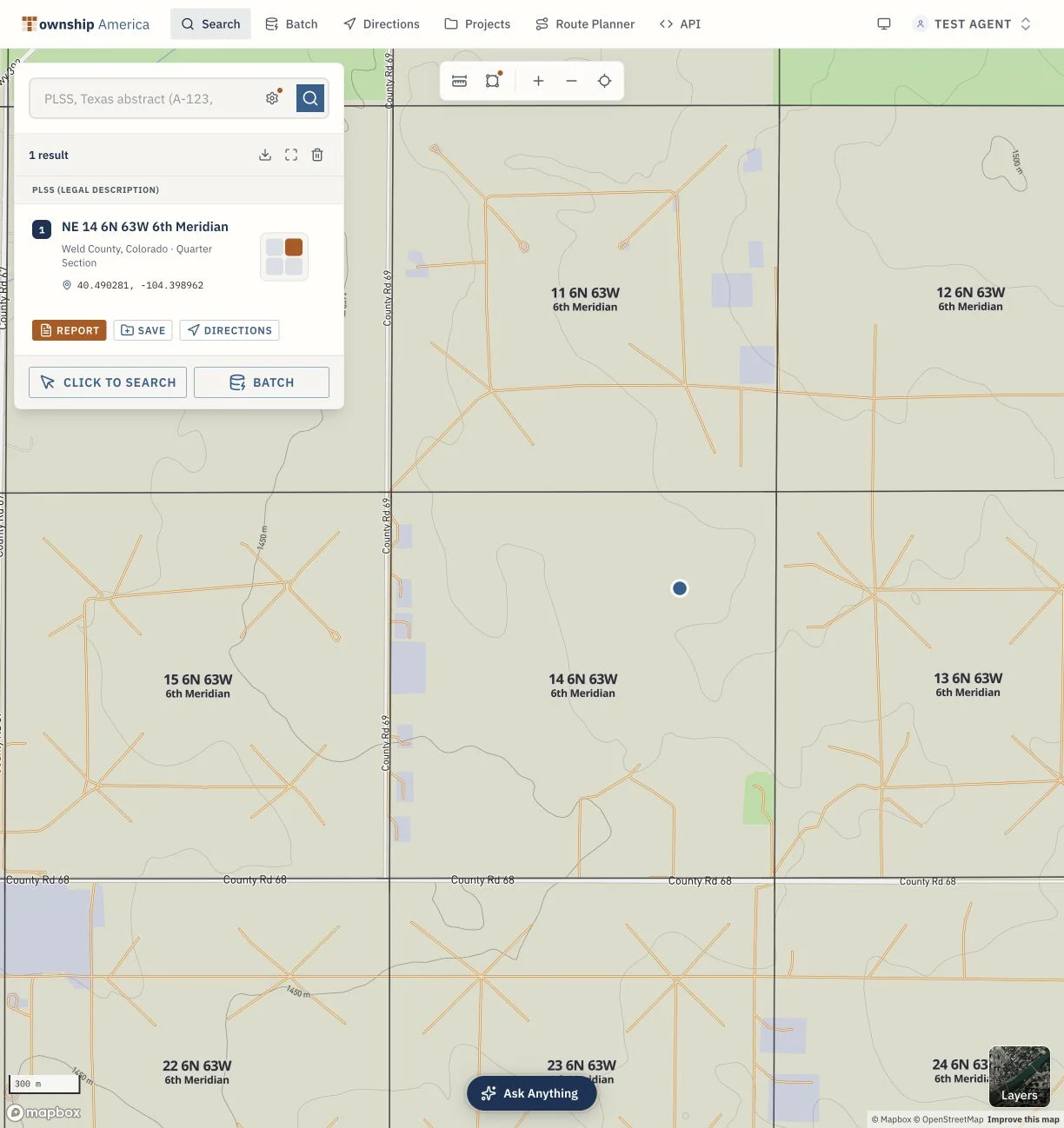
- Enter the legal description. Township America resolves it to coordinates and returns the full quarter-section boundary from official BLM survey data, down to the 1/256 aliquot part where you need to screen a smaller tract.
- Read the BLM leases intersecting the tract, then check the county-level ONRR totals for regional context. Those totals do not show what the specific interest has paid.
- Compare nearby wells with the production the seller represents, then obtain lease-specific production and royalty statements. Reconcile those records before pricing the interest; county totals cannot perform that reconciliation.
The report combines parcel lease and well data with broader county royalty context. Keep those scopes distinct in the acquisition file.
What to read ONRR data alongside
Royalty history rarely settles an acquisition on its own. In the same Energy pack session, on the same parcel, combine it with:
- Split-estate detection, to see whether the minerals are severed from the surface, which shapes access and future development on the tract.
- Offset-operator analysis, to see who is drilling around you and how active the area is.
- The Federal Energy Report PDF, which rolls the layers up into one document you can hand to the deal team, and which stacks with other packs into a single Combined Parcel Report.
Our walkthrough on offset wells and split estate for landmen covers that combined read, and the FracFocus disclosure layer adds a view of completion activity near the same tract.
When ONRR data alone is not enough
The royalty record is a strong early check, not a complete diligence file. It does not replace a title opinion that establishes who owns the interest and subject to what burdens. It does not replace a lease review that reads the actual terms, royalty rate, and continuous-operations clauses. And it does not replace an engineering reserve estimate, which is what tells you the future value of production rather than the history of it. Use the pack's county totals to identify regional questions, then use lease-specific records to verify production and income. Then let a title attorney, a landman on the lease terms, and a reservoir engineer confirm the parts the royalty record was never meant to answer.
Screening a producing federal lease this way costs minutes at the front of a deal and keeps a surprise from arriving after closing. See the oil and gas workflows the Energy pack supports, and pricing to add the Energy pack to Pro or Business.