Split-Estate Detection with the Energy Pack: What Landmen Check Before an O&G Acquisition
Split estate detection for oil and gas landmen: read federal subsurface minerals from a legal description before an acquisition offer goes out.
The costliest surprise in an oil and gas acquisition is the one that shows up after the offer letter. A team runs title, prices the deal against the surface owner, sends terms, and only then learns that the minerals under part of the tract belong to the federal government. The economics change, the permitting path changes, and sometimes the deal does not survive the revision. Split estate detection is the pre-offer check that keeps that from happening, and it is one of the first things an experienced landman confirms before anyone talks price.
This post explains what split estate is, why federal minerals ended up under so much private surface in the West, and how the Energy pack surfaces the split from a legal description so you can screen a lease before you commit to it.
What "split estate" means
A split estate is a parcel where the surface and the subsurface are owned by different parties. One person or entity holds the surface rights, and a separate party, often the federal government, holds the mineral estate below. In US property law the mineral estate is generally the dominant estate, which means the mineral owner (or its lessee) has a right to use as much of the surface as is reasonably necessary to develop the minerals. For an acquisition team, that single fact reorders the deal. If the target minerals sit under a federal estate, you are looking at a Bureau of Land Management leasing and permitting process, federal royalty obligations, and a surface-use posture that has nothing to do with the private surface owner you were negotiating with.
Split estate matters most in the states where it is common. It concentrates across the western oil and gas basins, with Colorado, Wyoming, New Mexico, and North Dakota among the places a landman expects to encounter it. Missing it is not a paperwork inconvenience. It can materially change price, void the assumptions behind an offer, or move the transaction into a regulatory track the buyer did not budget for.
Why federal minerals sit under private surface
The pattern is a direct result of how the West was settled. Early homestead laws transferred both the surface and the minerals to the settler. Later laws did not. The Stock-Raising Homestead Act of 1916 patented large grazing tracts to settlers but reserved the coal and other minerals to the United States. The result, a century later, is a checkerboard of parcels where a rancher or a later buyer owns the surface while the federal government still holds the minerals underneath. That reserved mineral estate is exactly the interest an O&G acquisition team needs to find, because it determines who you actually lease from.
Because the split follows old survey lines, it reads naturally against the Public Land Survey System. Federal mineral ownership is recorded and mapped against sections, townships, and ranges, so the right way to screen for it is to start from the legal description of the tract rather than from a street address.
What the Energy pack shows
The Energy pack (available on Pro or Business) is built to answer the pre-offer questions for a lease in one pass instead of across four disconnected data sources. For split estate detection, it maps federal subsurface minerals against the parcel where that data is mapped, so you can see which portions of a section carry a federal mineral estate. On the same grid it also overlays:
- BLM oil and gas leases on the parcel and county-level ONRR federal royalty totals for regional context
- Producing-state wells across CO, ND, OK, WY, and NM, plus federal wells from HIFLD
- The nearest HIFLD pipelines (gas, NGL, crude)
- Split-estate and offset-operator analysis
- USGS orphaned-wells liability screening and FracFocus disclosures
Those layers roll up into a Federal Energy Report PDF, which gives an acquisition file a single artifact instead of screenshots from five systems. The value here is not any one layer. It is seeing the split estate, the existing federal leases, and the royalty picture lined up against the same tract, because those three facts together tell you what kind of deal you are really underwriting.
How to read the split-estate layer
The workflow starts and ends with the legal description, so the screen is fast enough to run before an offer rather than after.
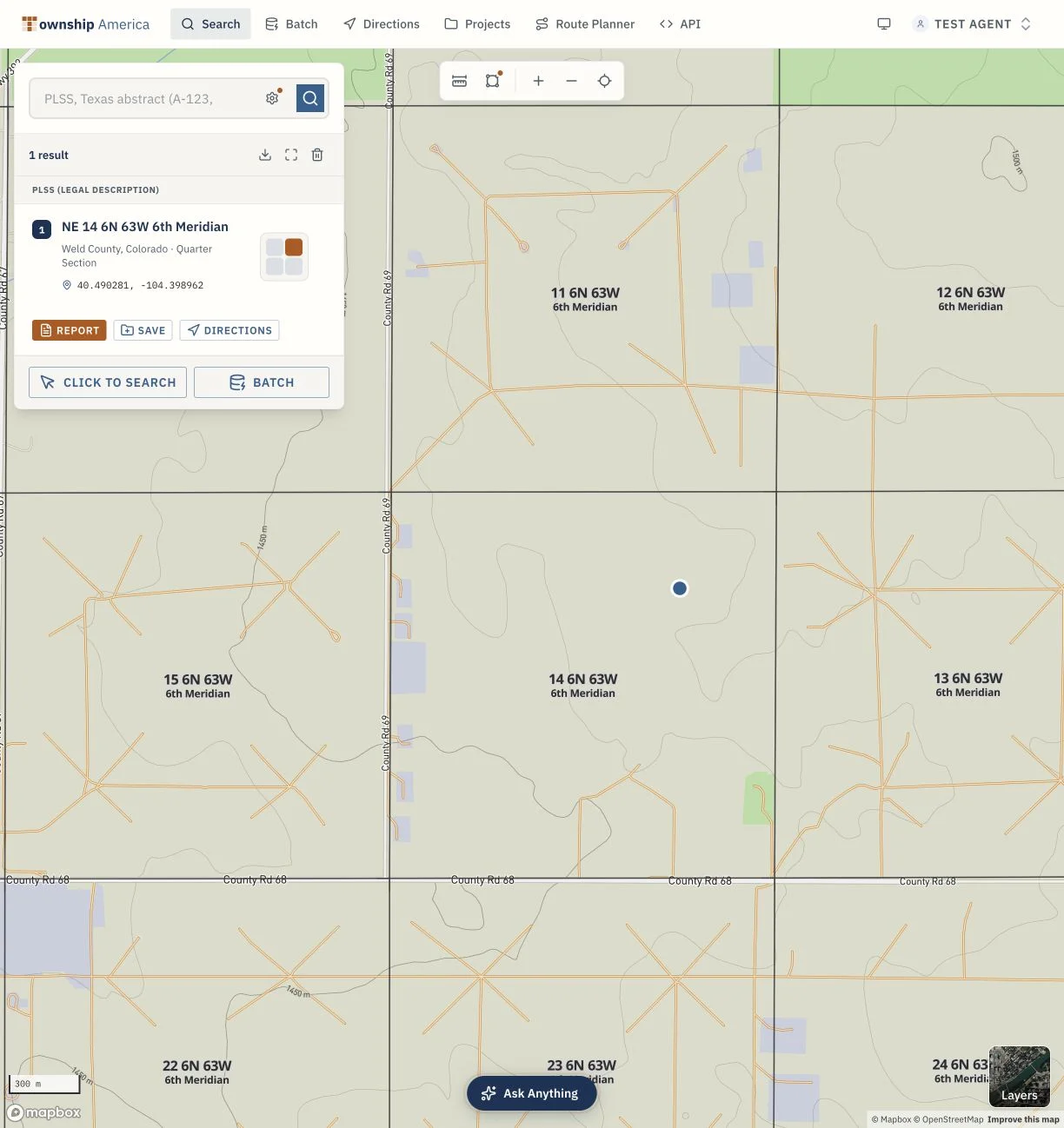
- Enter the tract by its legal description. For a DJ Basin example, that might be Section 14, Township 6 North, Range 63 West of the 6th Principal Meridian in Weld County, Colorado. You can convert the section, township, and range to coordinates and a section polygon in the same step.
- Turn on the split-estate layer and read it against the section boundary. Where federal subsurface minerals are mapped, you can see which aliquot parts of the section carry a federal mineral estate. It is common for the split to fall on part of a section rather than the whole, so read it down to the quarter or quarter-quarter, not just the section.
- Cross-check the federal leasing picture. If the split shows federal minerals, look at whether a BLM oil and gas lease already covers them and what the ONRR royalty totals say. A federal estate that is already leased tells you who holds it and changes your path to control.
The point of reading it this way is to separate what you observed from what you decide. The layer shows where the federal mineral estate is mapped. Whether that kills a deal, reprices it, or simply routes it through BLM depends on your position, your target working interest, and the specific tracts involved.
The companion check before you offer
Read split-estate ownership alongside offset wells, operators, and pipeline proximity. Together they show who holds the minerals and what activity surrounds the tract before terms go out.
Reading ownership and activity together is also how you avoid the mineral-rights confusion that trips up faster deals. If you are new to separating the surface and mineral estates on a tract, the mineral rights primer is a good companion to this workflow.
The takeaway
Split estate detection is a cheap check that prevents an expensive mistake. Confirming federal subsurface ownership from the legal description, before an offer, is standard practice for a reason: a split mineral estate can reroute the whole transaction. The Energy pack puts that check, the federal leasing and royalty picture, and offset-operator activity on one PLSS grid so an acquisition team can screen a lease in minutes instead of piecing it together after the fact. If your team works western O&G acquisitions, see how the Energy pack fits your diligence workflow and what stacks onto your Pro or Business plan.